
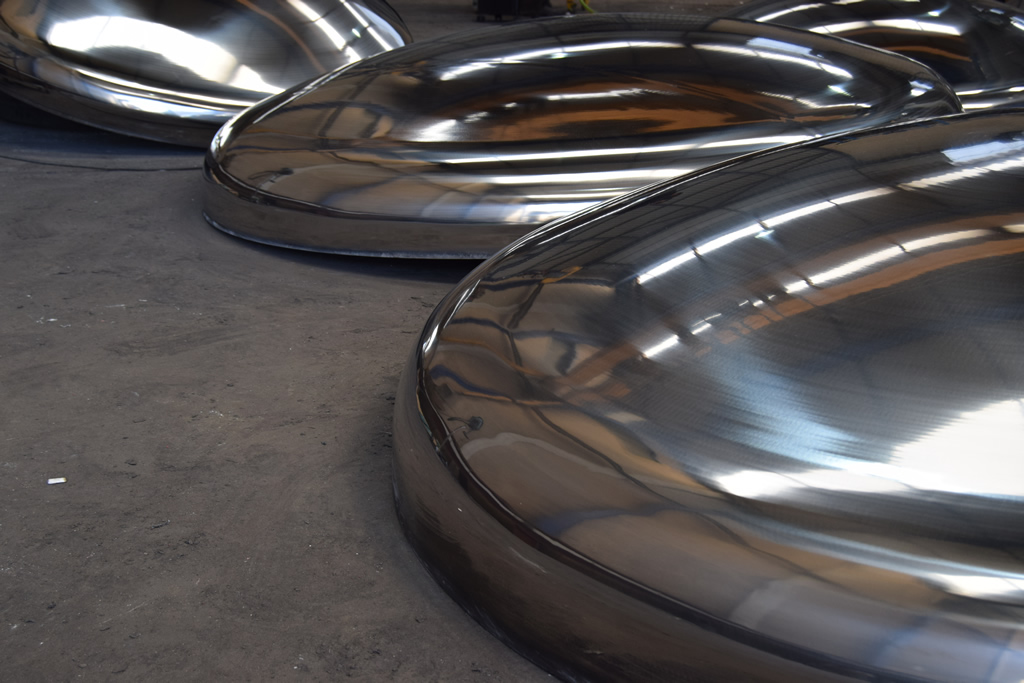
Surface finishes and controlled roughness for tanks and reactors
We provide sanitary and mirror polishing of stainless steel heads for tanks, reactors and industrial equipment for the pharmaceutical, cosmetics and food industries and other sectors with high hygiene requirements.
We have in-house polishing capability for large components and control surface roughness (Ra) using a MITUTOYO roughness tester, enabling us to verify and document the finish required for each project.
Surface finish: a critical factor in sanitary applications
In industries with high hygiene requirements, the surface finish of a tank is not simply an aesthetic consideration. Stainless steel roughness directly affects how easily the surfaces forming part of the equipment can be cleaned and maintained.
Inadequate surface roughness can hinder cleaning processes and encourage the retention of residues and microorganisms, increasing the risk of cross-contamination between different production batches.
At Steel Bombe Valley, we combine our stainless steel head manufacturing capability with in-house polishing and roughness control resources.
The aim is to achieve uniform surfaces and the finish and Ra roughness levels specified by the customer for each application.
This is particularly relevant for heads intended for:
- Process tanks.
- Industrial reactors.
- Equipment for the pharmaceutical industry.
- Equipment for the cosmetics industry.
- Tanks and equipment for the food industry.
- Industrial equipment and metal fabrication projects with specific surface finish requirements.
Polishing large stainless steel heads
One of our main capabilities is the ability to finish large components in-house.
We have 3 automatic polishing machines for heads and shells, capable of handling components up to 6,000 mm in diameter. This in-house capability enables us to undertake large metal fabrication and industrial equipment projects without outsourcing this stage of the process.
Polishing within our own facilities also makes it easier to control the manufacturing, finishing and inspection of the component before dispatch.
Sanitary and mirror polishing
We adapt the surface finish to the specifications set out in the drawings and technical documentation for each project.
We can provide different finish levels depending on the equipment needs, from industrial finishes to sanitary polishing and mirror finishes on stainless steel for applications requiring particularly carefully finished surfaces.
The required finish is jointly defined from the specifications supplied by the customer and the requested Ra roughness value.
Ra roughness control and certification with a MITUTOYO roughness tester
The visual appearance of a surface is not sufficient to determine its roughness technically.
For this reason, we have a high-precision MITUTOYO roughness tester to measure the Ra surface roughness parameter and verify that the finish achieved meets the specifications established for the project.
On request, we can document the roughness values obtained, providing the customer's technical or quality department with the necessary traceability of the component's surface finish.
This capability is particularly relevant for manufacturers of tanks, reactors and industrial equipment intended for sectors such as:
- Pharmaceutical industry.
- Cosmetics industry.
- Food industry.
- Chemical industry.
- Specialised industrial metal fabrication.
Edge preparation and bevelling
Finishing a head does not end with its surface.
We can also prepare and bevel the edges of the head to facilitate its subsequent integration into shells, tanks or welded assemblies.
We carry out this preparation according to the project's construction requirements, aiming for a precise fit and suitable geometry for subsequent welding operations.
This allows the customer to receive a component prepared to the specifications set out in their manufacturing drawings.
Manufacturing to customer drawings and specifications
Each head is manufactured and finished following the construction drawings, geometries, tolerances and finish specifications supplied by the customer's technical office.
Our team first reviews the project requirements to determine feasibility and define the most appropriate manufacturing and finishing process.
We can work on both one-off and special projects and the recurring requirements of tank manufacturers, metal fabricators, engineering companies and industrial equipment builders.
Confidentiality and NDAs
We understand that manufacturing drawings may contain sensitive information about tanks, reactors, patented equipment or the customer's own developments.
We can therefore work under non-disclosure agreements (NDAs) from the earliest stages of the project's technical assessment.
Protecting and packaging finishes during transport
A sanitary or mirror finish requires particularly careful handling once polishing is complete.
For projects that require it, we design packaging solutions adapted to the dimensions and characteristics of the component, with the aim of minimising the risk of friction, marks or damage during handling and transport.
This is particularly important for large heads and domestic and international shipments where the surface finish must remain protected until receipt.
Frequently asked questions
Frequently asked questions about polishing and finishing stainless steel heads
What is the difference between sanitary and mirror polishing?
Sanitary polishing aims to achieve a uniform surface with controlled roughness suited to the equipment's hygiene needs. Mirror polishing takes the surface finish to a very high level of visual reflectivity. The choice depends on the technical, functional and aesthetic specifications of each project.
What is Ra roughness in stainless steel?
Ra is one of the parameters used to express the average roughness of a surface. It allows the surface finish to be quantified and provides an objective check of whether a component meets the roughness level specified in the project.
How is the roughness of a stainless steel head measured?
At Steel Bombe Valley, we carry out checks using a MITUTOYO roughness tester, which measures surface roughness and verifies the Ra value obtained after finishing.
Can you certify the Ra roughness of the finish?
Yes. On request, we can measure and document the surface roughness values obtained using our MITUTOYO roughness tester, providing the customer with objective information about the component's finish.
What is the maximum diameter you can polish?
We can polish heads and components up to 6,000 mm in diameter, allowing us to work on stainless steel heads for large tanks and industrial equipment.
Do you mirror-polish heads for the pharmaceutical industry?
Yes. We finish stainless steel heads for tanks, reactors and equipment for the pharmaceutical industry, adapting the polishing and roughness levels to the technical specifications provided for each project.
Do you also work for the cosmetics and food industries?
Yes. We manufacture heads and provide surface finishes for equipment intended for the cosmetics and food industries, as well as pharmaceutical, chemical and other industrial metal fabrication applications.
Can you manufacture and polish the head to our drawing?
Yes. We work from the customer's drawings and technical specifications, assessing the required geometry, dimensions, tolerances, material and surface finish before manufacturing the component.
Can you supply heads with edges prepared for welding?
Yes. We can prepare and bevel the edges according to the construction requirements specified by the customer, facilitating subsequent integration into the tank or welded assembly.
Can we send confidential drawings to request a quote?
Yes. We can work under non-disclosure agreements (NDAs) to protect the drawings, designs and technical documentation supplied during the project assessment.
Request a technical assessment and quote
Do you have a technical drawing, a head diameter or a roughness specification you need a quote for?
Send us your project documentation and our team will assess manufacturing feasibility, the required finish and the component's specific needs.